
ZGpeptide / Research articles
Peptide Purity vs. Peptide Content: Why 99% Does Not Tell You the Amount
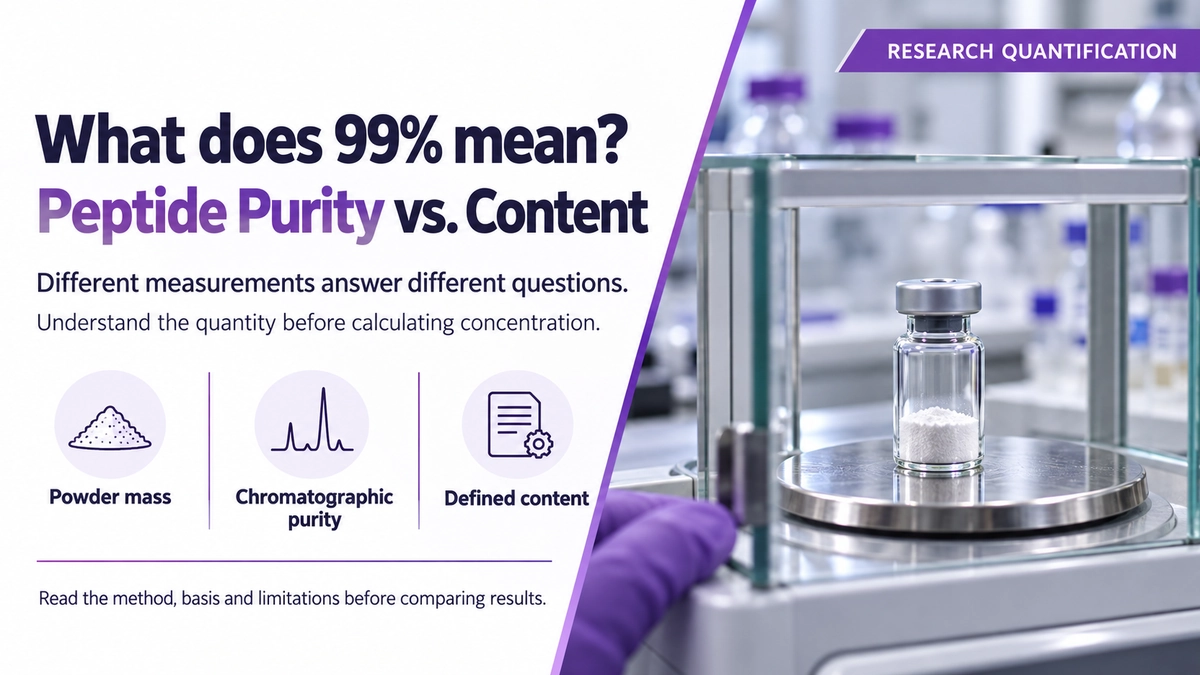
Peptide purity and peptide content describe different properties. Chromatographic purity describes the target's response relative to other detected components under a defined method. Net peptide content describes a peptide-related mass fraction on a specified basis. Neither should be confused with the total powder weight printed on a vial.
This distinction matters whenever you prepare a stock for quantitative research. If you assign concentration from the wrong quantity, a well-executed experiment can begin with an incorrect starting assumption.
The solution is to define the quantity you need before choosing a calculation.
Three Numbers That Often Get Confused
| Quantity | The question it answers | A common misinterpretation |
|---|---|---|
| Gross powder mass | How much material was weighed? | All of that mass is the target peptide |
| Chromatographic area purity | How much selected detector response belongs to the assigned target peak? | The result is automatically target mass divided by total powder mass |
| Defined peptide content or assay | How much peptide-related or target material is present on the stated basis? | Every laboratory uses the term in exactly the same way |
A dried peptide preparation can include water, counterions and other non-peptide components. Related peptide impurities may also contribute to some content measurements. Read the method and definition rather than assuming a label resolves those distinctions.
“Content” is especially easy to misread. Some measurements concern total peptide material; others assign the target analyte. These results may support different calculations.
AI-generated educational illustration; not an actual laboratory photograph, product specification or test result.
Why HPLC Purity Is Not Automatically Mass Purity
HPLC separates components under selected conditions, and a detector measures a response. An area percentage depends on what was detected, resolved and integrated.
Some components may respond weakly at the selected wavelength. Others may fall outside the integration window or overlap the target peak. Different components can also have different response factors.
This does not make chromatographic purity unhelpful. It makes the method's scope important. The percentage is valuable for understanding a defined analytical profile, but it should not silently become a universal measure of every substance in the powder.
When a specification says only “99% pure,” the useful follow-up is: 99% by which method, on what basis and for which purpose?
AI-generated educational illustration; not an actual laboratory photograph, product specification or test result.
Use a Calculation That Matches the Measurement
Consider a hypothetical research sample containing 10.0 mg of gross powder. Assume a validated, target-specific assay assigns the target peptide a mass fraction of 0.800 on the same as-received basis as that powder weight.
The assigned target mass is:
10.0 mg × 0.800 = 8.00 mg of target peptide.
If the sample is prepared to a final volume of 4.00 mL with complete recovery, its assigned target mass concentration is:
8.00 mg ÷ 4.00 mL = 2.00 mg/mL.
Those numbers are illustrative, not product specifications. The calculation assumes compatible measurement bases, complete transfer and dissolution, and an appropriate assay. It does not imply that every vial contains 80% target peptide.
Now suppose the certificate instead reports 99% HPLC area purity but gives no content assignment. You cannot simply substitute 0.99 for 0.800. The chromatographic percentage has not established the required powder mass fraction.

AI-generated educational illustration; not an actual laboratory photograph, product specification or test result.
Do Not Apply the Same Correction Twice
A frequent mistake is multiplying gross mass by both a content figure and an HPLC purity figure without checking what either measurement already includes.
If a target-specific assay already assigns the target mass fraction, adding another purity correction may double-count an adjustment. If a content result includes related peptides, further interpretation may be necessary, but a raw area percentage is not automatically a valid mass correction.
Ask the laboratory or supplier to explain the intended calculation and its assumptions. A sound answer identifies the measurand, calibration, mass basis and relevant uncertainty. An unexplained formula creates false precision.
The same care applies when converting to molar concentration. Use a molecular-weight convention consistent with the defined analyte and reported mass assignment. Do not mix free-peptide and salt-form quantities without accounting for their basis.
Write a Specification That Removes Ambiguity
Compare these two fictional specification statements:
Ambiguous: “Peptide, 10 mg, 99% purity.”
More useful: “Defined sequence and terminal modifications; chromatographic purity reported with method; quantity basis identified; target content assigned by an appropriate quantitative method; batch-linked results provided.”
The second statement does not impose a universal test panel. It makes the quantities interpretable. Depending on the study, you may need a validated concentration in solution rather than a nominal powder amount.
Keep acceptance criteria proportional to the experiment. An exploratory qualitative assay and a calibration study do not necessarily require identical quantitative characterization.
Troubleshoot Concentration Disagreements Systematically
When two preparations behave differently, do not immediately conclude that one batch is impure. First compare the assigned quantity, dilution records, recovery, solubility and handling history.
| Observation | Question to investigate |
|---|---|
| Similar purity but different apparent activity | Were target concentrations assigned on the same basis? |
| Lower signal after extra transfers | Could adsorption or incomplete recovery contribute? |
| Inconsistent results after storage | Were stock stability and thaw history controlled? |
| Different reported content values | Do the methods measure the same quantity? |
Can a peptide have high purity and lower net content?
Yes. Chromatographic purity and non-peptide contributions to powder mass are separate issues. The actual interpretation depends on the methods used.
Is amino acid analysis always target-specific?
No. It measures amino acids after hydrolysis, and interpretation depends on composition, contaminants and method design. Do not assume it distinguishes the target from every related peptide.
For your next quantitative study, establish the target quantity first. A clearly defined concentration is a stronger starting point than a reassuring percentage whose meaning has not been checked.
Review the material and evidence relevant to your research before making a decision.
Contact details